Showing posts with label South Africa. Show all posts

14 January 2010

Seeing Humanity


Sawubona is one of the greetings in South Africa. It's a sibling of our hello, hey, yo! And it's so much more than that. This Zulu term literally means, "we see you." The response is Yebo, sawubona: we see you, too.

Imagine the freedom we might experience in this world if we were to really see each other—with our eyes, our hearts. Might we dismiss each other less? Judge each other less? Pay more attention to those who take our money at a coffee shop, hold cardboard pleas on the roadside, teach our children? Or even those who live in our neighborhoods and homes—those who some of us only pretend to see?

I came across this free online magazine Humanistic Report, and I like that their mission seems simple: tell the stories and show the images that might help people see each other.

May we all see both the heartbreak, healing and happiness happening in our midsts and in places we may never visit in the world. And may we recognize it all as humanity.

Other places to really SEE people:
Pray With Africa
Global Oneness Project

Which others do you know?


p.s. i was originally drawn to this 'zine because the first issue features children from Burma. they were likely all born into war and fear. and yet they look like students of joy and peace to me. i hope . . .

18 August 2009

Truth ampersand Reconciliation


I'm reading poetry by Dennis Brutus, a South African poet and activist (thank you kindly, Will, for the introduction). His poetry, first of all, is beautiful. The few pieces I've read take me into his jail cell (he was imprisoned at Robben Island for 18 months) and strike my bones. It's honest, lyrical, haunting.

So as I've read more about him, I learned that he refused an induction in the South African Sports Hall of Fame at the end of last year. His activism played a major role in an international sports boycott of apartheid South Africa, which banned them from the Olympics starting in 1970 and ending with the fall of apartheid. I suppose they wanted to honor him for his commitment to bettering SA sports. But Brutus publicly declined the induction, stating that many of the people currently in the Hall of Fame are there at an "unfair advantage, as so many talented black athletes were excluded from sport opportunities." So he gracefully (much to the chagrin of the committee, I'm sure) declined, saying that "it is incompatible to have those who championed racist sport alongside its genuine victims. It's time--indeed long past time--for sports truth, apologies and reconciliation."

I find this story quite interesting to think of how brave it is to really call a people to real reconciliation. When South Africa became a new country, the waved a new flag, sang a new national anthem, adopted many new national languages. These are mostly symbolic, but they are the necessary symbols to begin saying, "we are truly going to live into something new." I love that Brutus is calling even the Sports Hall of Fame to the same kind of newness, even to simply recognize the fallacy of their work during the apartheid era. If a country is going to live into truth and reconciliation and even champion the cause, it must do it in all facets of its life.

My sister L and I have been discussing for years, "why hasn't the U.S. had our intentional process of truth and reconciliation?" We have certainly come a long way. I am a generation removed from any strange fruit dangling from southern trees. Our president is biracial. No doubt that we are in a far better place. And, yet, I still can't wrap my mind around Emmett Till's 1955 lynching and how his murderers actually confessed to the murder without any justice being served or any intentional moves toward reconciling their wrong.

And we have so many examples of where we never spoke the truths or really reconciled. In fact, my friend K and I were talking the other day about how taboo it still is to talk about race in the U.S. Having both spent time in South Africa, we were impressed with how freely the people we met speak of race (sometimes appropriately and sometimes offensively--but the taboo of addressing race doesn't seem as strong). Whereas here, I've heard people remark that President Obama's election has started to awaken bitter race relations in our country. This is not true. This divide has been alive and very much awake (just look at a photograph of a high school cafeteria in Greenville, SC); we just don't talk about it or acknowledge it or look it in the eye. The election placed a mirror in front of us and forced us to see the truth: we've never really intentionally reconciled. Our flag still looks the same. Our song still sounds the same. Some people boycott MLK's birthday celebration. I get followed at a three-letter clothing store because I'm a black woman of a certain age, while 14-year-old and white Johnny stuffs a baseball cap under his shirt. Hispanic people are consistent targets of racial profiling. I'm still an "other" in this nation that has been mine since birth, and I'm labeled "bitter" or an "angry black woman" whenever I mention this.

We have miles to go before we sleep, and I hope that we'll be so moved to practice truth and reconciliation in our future days. Only when we hear each others' stories and begin to hear/see each other can we move toward healing.

06 March 2009

Vote for More Than One Day!


Hello! I volunteer with the youth group at my church and have the opportunity to serve with some of the neatest young people. They are more than your average teenages--their hearts for justice is inspiring! This summer the group is traveling to South Africa and Swaziland to serve alongside Come Back Mission--a local South African organization based in Jo'burg. This is going to be an incredible pilgrimage, and I'm excited that they will get to meet some of my good friends in South Africa.

Please take a minute to vote for Belmont United Methodist Church at Trevecca's More Than video competition. The winning group receives money towards their mission, and it will certainly go a long way with Belmont UMC. You can vote only once each day, but you can vote more than one day! Please do! Thanks!

13 April 2006

Ahhh . . . Maundy Thursday


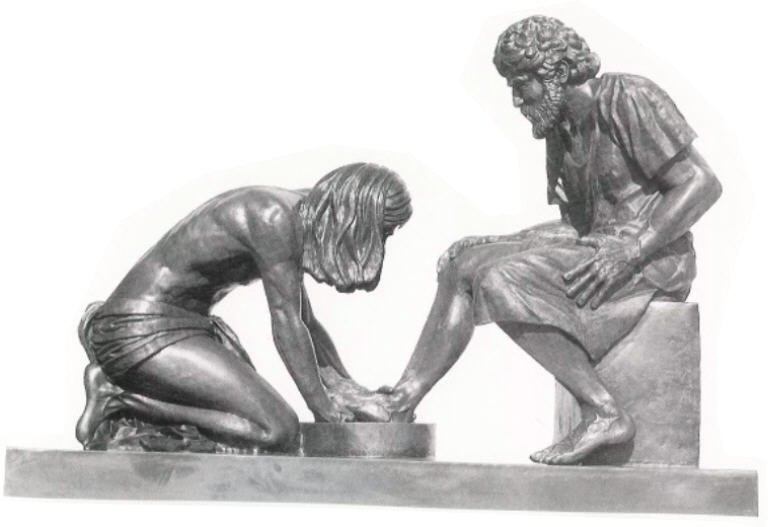
It's that service I think is ever so important in Holy Week, but really I usually just struggle. Because on Thursday I know I'll have to remove my shoes, reveal my feet and let someone (who is not a trained pedicurist, mind you) touch them. Even worse, depending on how the worship is shaped, I just may have to touch someone else's revealed feet, as well! Each year I cringe. But I also have deep respect for the humility of the Christ in this situation. It takes a lot of deep love and humility to wash the disciples' dirty, nasty, "we've-walked-in-sandals-all-across-the-dusty-land-following-Jesus" feet.

I did not cringe this year, however. I rolled the hem of my jeans and was served. And I served my sister, as well. And I remembered a young man in Johannesburg. He was an angry young man, as he was bedridden as a result of disease. And his feet were bandaged. His body was bandaged to cover the many bed sores taking over his skin. We walked into his room, and they handed me supplies to remove his bandages and to wash his feet.

The "we" who went to this man's home with me are a group of young South Africans who daily walk the dirt streets and sometimes through the "bush" to get to people's homes who were suffering HIV/AIDS and other house-ridden disease. Their daily lives consisted of great humility to bring vitamins and food to those who could not leave, to sit and talk to those who were now ostracized and to, of course, wash this man's feet and the rest of his body.

I remembered them this year as we sat in the sanctuary this Maundy Thursday. I thought of their passion--a passion that is, indeed, the passion of the Christ. I remembered this man who could barely speak English and how he let me wash his feet. And I remembered Jesus who daily serves me, a foolish soul certain to betray and beg for forgiveness. I remembered, and I washed and was washed.

And not once did I cringe.

How beautiful are the feet of those who bring good news! Rom. 10:15

I'd love to hear your feet-washing stories . . .

01 February 2006

Celebrating Virgil!

I met Virgil in South Africa. He dated Lynne, a cousin of the Pillay family I stayed with in Johannesburg. He's not someone I saw each day. He was always at church and at the house on weekends. He and Lynne reached out to me since we were all close in age. We watched movies together. He toted me around in his car at times, carrying my big red bag from house-to-house. I often had to ask him to repeat everything he said because his accent was deliciously thicker than the others. Lynne would laugh and say that they didn't always understand what he was saying, either.

Virgil insisted that I fall in love with South Africa. He wanted to make sure I tried all of the good sweeties, so he stopped at a store and purchased South African and Indian goodies for me. I'm certain I broke his heart when one sour candy nearly made me want to cut my tongue out of my mouth. I assured him I loved the country, though. He asked me what I'd tell everyone about Johannesburg when I got home. Virgil said he was sick of hearing how Johannesburg is one of the most dangerous cities in the world. He wanted to make sure I went home sharing how safe I felt in most places. He imagined it was like any other city--you just know where not to go and avoid those places. His little boy--about 4 years old--stared at me and laughed at my accent when we met. Payback for me asking his dad to repeat all of the time, I guess.

When I was there, Virgil was sick most of the time I saw him, coughing a lot and having to rest at times. When I finally asked about his cold, he told me he had Leukemia and was awaiting a bone marrow transplant. I received an e-mail this morning saying that Virgil succumbed to the disease Dec. 19. Today I celebrate Virgil--the few weeks of his life I was able to experience! I pray for his family and friends who are learning a new way of living without him right now.

01 December 2005

World Aids Day


Eunice is Isaac's mother. He's about 30 years old. I do not know Eunice's age. They both are HIV+ and ridiculed daily in their Johannesburg community. Surely Isaac slept with his mother and passed it on to her, people say.

Kevin is married in a South Carolina town. He has to reveal to his wife that he contracted HIV from someone else.

Angeline is frail and living with HIV. Everyday she cares for other HIV/AIDS patients in her community in Johannesburg, though, walking long, dusty streets in spite of and maybe because of her disease.

Larry, a Britishman, quits his suit-and-tie job and begins educating children--British and South African--about HIV/AIDS after discovering he contracted the disease. MADaboutART was birthed.

These people I've met and millions upon millions of others I will never see live with HIV/AIDS daily. Remember them today and everyday. Pray for them. Write letters encouraging our nation to support them.

People live with and die from AIDS. It's not easy to face this fact. But we must. We must face it each day.

19 November 2005

Another Ending to the Story, Please!

He was tall, handsome, educated and strong. And yet he was unable to save their lives. I was early to meet the team at Quay 4, a restaurant in Cape Town, South Africa, so he and I began talking.

His name is Germain. I’ve written about him before. His family was murdered in the Democratic Republic of Congo--a country with supposed peace after five years of Civil War. Unfortunately, even after the signing of several peace treaties and cease-fires, tensions still exist. Homes are ransacked. Women and their daughters are raped. People are being killed.

Germain’s wife and two little girls are only three of the hundreds upon hundreds of people killed.

My friend Hilaire is from DRC, and he’s managed to get out and enroll in a PhD program in Canada. His life was threatened constantly when he was there. Financial supporters and friends were able to get him out of danger. Unfortunately, his family was not able to get away. They are still there being harassed, attacked and threatened.

I pray that Hilaire does not have to adopt Germain’s story. I pray that his family is able to find asylum somewhere. Anywhere but there.

Learn more about DRC.


Photograph of the Peace Pole was taken at Regina Mundi Church in Soweto, a beautiful place of grace and reconciliation. This church played a strong role in the anti-apartheid movement even after police fired mercilessly on a group of students gathered in the church for sanctuary and conversations about the movement. The church is a sign that peace is possible.

10 November 2005

Remembering Sweet Lisa (Part 2)

(Lisa moved in closer as I took a photograph of her. It's all out of focus except her earlobe now, but I still love this photograph)

I must admit that I helped the team very little the days they built the soup kitchen for Concordia Methodist Church on top of the hill in Knysna, South Africa. Instead, I played with Lisa.

She is a sweet girl, eager for me to hold her and hug her. Many people asked if she was my daughter, which I loved. The maternal being in me has been dormant, and I’ve never desired to be a mom anytime in the near future. I shocked myself with my instinct to be with her. We fit each other. She did not speak much, but she smiled and laughed and played. She clenched my hand as we prayed. And she listened as I talked, talked, talked in English. She would nod her head in agreement or sometimes giggle and shake her head furiously to inform me that I was asking a silly, silly question. She cried as we said goodbye at the end of the day. And she ran to me with an incredible glow when we saw each other again.

Lisa lives on the hill where she and the other Xhosa-speaking South Africans can look down upon their gorgeous town, which really doesn’t belong to them at all. They have the most beautiful view of Knysna, overlooking the Knysna Lagoon and the Indian Ocean. They see the gorgeous homes on Leisure Isle where the British, U.S., Australian citizens and people from other wealthy countries in the world own vacation homes they occupy a few months of the year. They see the extravagant homes and beautiful living of the white South Africans. They see this from their homes, which look like mere shacks, have no heat and often no running water or electricity.

The so-called 3rd and 1st worlds co-existing . . . sadly, the people on the hill always had to acknowledge what was down below. The people below could live life without ever looking up.

I met a young lady named Noxee who showed me her home on the hill, and she said, “We have such a beautiful view! I love it!” She didn’t complain about the disparity. Some children asked me to climb higher on a hill with them because they wanted to show me their great view. They didn’t mention the amazing homes below or the boats lining the lagoon. They showed me the ocean and marveled at its beauty.

As I remember Lisa I wish for her to go to school, grow in her dreams and get down off the hill. I want her to have the opportunities of her country that all the rich white kids have. I want her to keep the spirit of the hill, though, as she captures these other things. It is a spirit of love. It is a spirit I love.

This felt like home. This made sense to me. It helped me see the people from whom I come . . . and they are loving, giving, proud people. Passionate, musical, moving people. Hopeful, strong, persevering people. People who lean on hope in the midst of obvious trials. People, like Noxee, who appreciate their beautiful view instead of envying other’s possessions. I am very proud to come from Africa. From my journal entry 5 June 2005 after my first day on the hill
(Noxee and me)

04 November 2005

Remembering Sweet Lisa (Part 1)


I stared at some children beyond the wire fence. They journeyed back-and-forth several yards between a home and a tiny store, settling every once in a while on a patch of grass between the two places. This was their career.

I began taking photographs of them eating their apples on the patch of grass. I watched them walk back-and-forth. I wondered who they were. And I wanted to play.

When my lens would not zoom any further, I drew closer to them, stood on their grass and said hello.

“Auggghhhh! Auggghhh! Auggghhhh!”

They hiccupped their screams as tiny feet ran quickly across gravel and dirt road into the house. The back-and-forth ceased. They moved inside-and-out from inside the house to just enough out of the door to see if the weird talker was still usurping their office space.

I laughed and played our little game of peek-a-boo, wishing I hadn’t scared them. I wanted to think they were intrigued by me and wanted to play, as well. They were genuinely frightened, though, and disturbed that I had taken their grass.

A little disappointed by their not wanting to play with me, I considered walking back to the church inside the fence and taking more photographs of the Belmont UMC youth laying foundation for the soup kitchen we were building in this South African community in Knysna. My head turned towards the church, and I saw a cow . . . in the middle of the road.

And even more beautiful, my eyes caught a tiny little girl in front of the cow checking out what was going on in the church yard. Then she turned and looked at me with every bit of my intrigue reciprocated. I patted the grass next to me, and she accepted my invitation.

I spoke. No screams, no running away. She simply looked at me and inched closer. I asked her name.

“Lisa,” she said.

Externally I smiled, and I’m sure more words fell from my mouth even though Lisa primarily spoke Xhosa. My internal smiles were far louder. Sweet Lisa, traveling with a cow, captured me immediately. My soul beamed. And it still does as I recall this first memory of Sweet Lisa.

03 October 2005

I am Woe no more . . .

Amazing grace! How sweet the sound of Mark (the Acklen P.O. worker whom I annoyed once again with a phone call about my journal) when he said, "This is your lucky day! Somehow it's here now."

Hallelujah!

My journal has come safely home! My memories are not lost. Although, in this process of loss I learned that I carry a lot more with me than I thought I did.

Yippee!

27 September 2005

Woe is I

There were some days I left my camera in the room where I stayed in South Africa this past June. We visited some lovely places on those days, too, but I did not take my camera with me. I opted instead to see the world through my two lenses and not rely on a 4 x 6 to capture a memory.

I did take my journal with me, though. While it may not hold elaborate, publishable thoughts, I did use it on those days to record verbal snapshots of what I was seeing and experiencing. It holds names of people I met, names of places I visited and imagery of the ocean slamming against the rocks in Knysna. It houses frustrations with our hosts, recollections of being sick, and broken-hearted thoughts about South Africa's history. It tells of sad days when I missed Lanecia, joyful moments after a late-night phone call from Jay and special minutes of hearing someone share their story with me.

Even with camera in tow, I relied on placing memories in my journal, as well.

So this is my lament.

I took the journal inside the Post Office today. This journal also contains addresses for some people dear to my life, and I had it with me as a reference for mailing a package. I am the queen of absentmindedness at times, and I managed to walk away from the P.O. without my journal.

When I returned to the Acklen P.O. about 30 minutes later, they had no books in the lost & found.

So my purple book of thoughts, poetry and memories is no longer with me anymore.

21 August 2005

I'm Back!/Your lesbian is due back in 45 minutes . . . late fees will ensue!

Ok . . . so I've returned to the blog world after my tiny hiatus from computer life. In the meantime, I've been blessed to have my sister return from England and be my roommate for a few weeks. Lanecia is the new youth pastor at the church I attend, so we're back in the same city again for the first time since high school. It's lovely! Until she's able to move into her apartment in September, we're sharing the same bed again for the first time since kindergarten, I think. Not quite as lovely!

Lanecia flew into New York City, and we drove down from NYC to Nashville via South Carolina. In SC we visited my maternal grandparents, my aunt, my cousin, my paternal great-grandmother and great-aunt/uncle. I've not seen any of them in so long, it seems. We enjoyed being in their presence again even though our time was limited. Granny is 94-years-old and looking wonderful!

Life is good; I can't complain!

============

Wanting to know more about gay people, but not quite sure you want to be their friend? Curious about Islam, but not quite sure you want to step into a mosque and ask a question or two? Well, Sweden has the answer for those of us in the world ready to take our curiosity one step further but not quite far enough to step completely out of our comfort zones! How about going to the library and, instead of checking out a book on Eastern religions, rent your very own Hindu person for 45 minutes: http://www.planetout.com/news/article.html?date=2005/08/17/4.

I applaud this Swedish library's desire to promote diversity. Maybe in their 45 minutes together, people will decide to further develop relationship with each other, realizing that you cannot truly know a culture or understand a person in 45 minutes. It's sad, however, that the library has to offer space for such interaction. Do we divide ourselves so much that we must rely on the booklenders to loan us people now? Are we that confused about creating community?

I'd like to shake my head and say this is a problem of Swedish culture and their lack of integration. Unfortunately, though, I learned that you have a different experience in their country depending on which South Africa you visit: the Indian one, the black one, the white one or the coloured one. Their libraries may need to do some people-lending, too. And we're not so happily integrated in the USofA, either. At the Duke Youth Academy a few years ago, counselors and youth had to fill out sheets to talk about how many people in our close circles of friends (the friends frequently visiting our homes) are of a different race, socio-economic class, sexual orientation, etc. Sadly, most of us could not claim interaction with people not like ourselves. Just the other week, Lanecia told a story and mentioned her Islamic friends. When she said this, a woman to whom she was speaking questioned, "Do you mean Islamic friends who are now Christian?" She asked more questions, unable to wrap her mind around Lanecia having "friends" who are not Christian.

Maybe people-lending is on our horizon, as well.

Or could we dare, as absurd as it may seem, to know our neighbors?

17 July 2005

Cameras, Refugees and Prayer


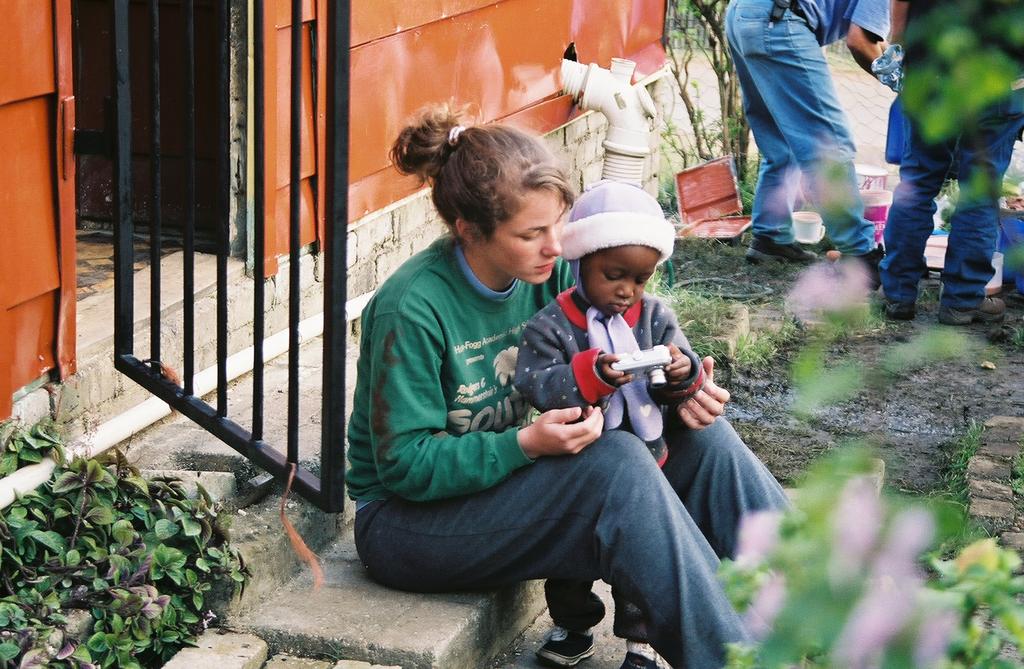
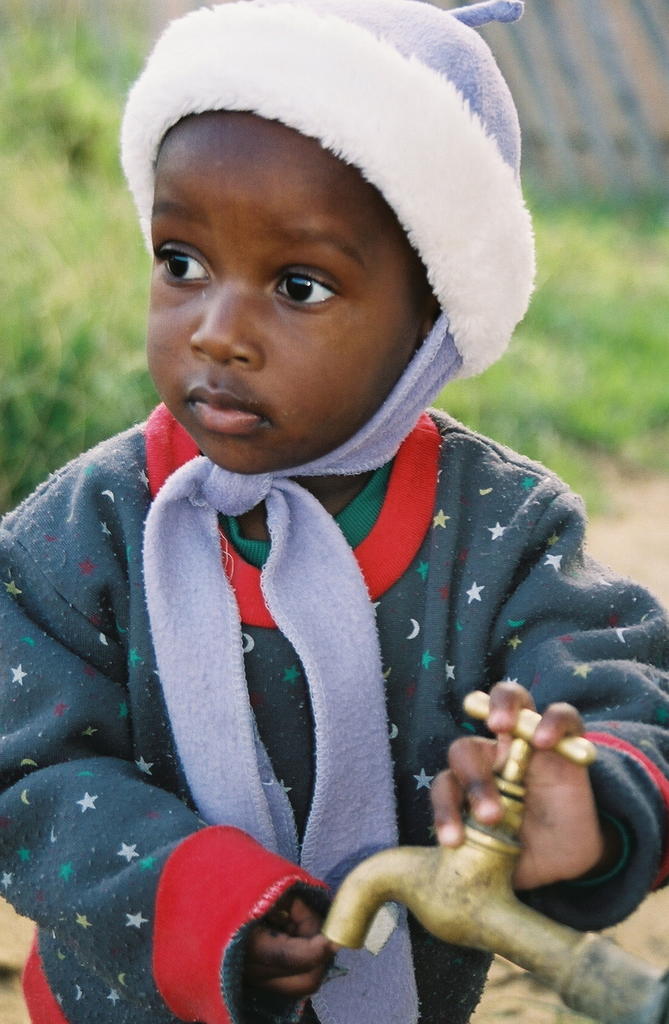
In this photograph Liza (18-year-old Belmont youth) is showing 2-year-old Nestashine a photograph on the digital camera. The children we got to know all loved the digital cameras. They were terribly disappointed when I pulled out my Nikon SLR manual camera with the 35mm film. I'm sure they were thinking: "What kind of American are you? It's 2005 and every American owns a digital camera!" I think I became acceptable again, though, when I used the Polaroid camera and let them keep the photographs.

Anyway, we met Nestashine when we worked to paint a creche (preschool) in the Khayeletu township in Knysna, South Africa. Her father Innocent is a sculptor who sometimes gets work with a painting business if they need a paint job done on a building. Since we were painting the creche, Innocent became our friend, helping us get the work done the entire two days.

So we spent only two days with Innocent, his wife Linah and his daughter Nestashine, but we tried our best to get to know them. They moved to South Africa fleeing Harare, Zimbabwe. He talked about how dangerous it was there sometimes with the government just coming in and threatening families, knocking down homes, harassing entire communities. He's not making much money, but he's working hard. So he's found his peace in South Africa but almost got an opportunity to come to the USA for work. He's still praying for that opportunity.

I met a number of refugees into South Africa. Since South Africa's freedom and new government in 1994, people from war-torn countries on the continent of Africa have fled to the Republic of South Africa. I met Germain early in our trip when we visited a restaurant in Cape Town where he worked as security. Germain is from the Democratic Republic of the Congo, and we talked for a while as I waited for the rest of the group to meet me at the restaurant. Our conversation covered many different topics from what his neighborhood was like to why our group was in South Africa. He let me practice my French. We talked about churches.

When I finally asked about the tension in the Congo, he said that rebel fighting in parts of Rwanda, Burundi and the DRC had gotten so bad it was terrifying. I asked if he had family there still or if they came with him to South Africa. He then told me that his family--wife and two tiny girls--were killed by rebel forces. After their deaths, he became a refugee in SA. He has a university degree he acquired in the DRC but can now get only this job to start his new life. But he says that God is blessing him. And he sends money home to his mother (who was too old and ill to flee with him) whenever he can.

On another note . . . A few days after meeting Innocent and family, we met their neighbor Robert at a marketplace selling his things. He shares an HIV infection with his baby boy Joseph. He was thrilled to finally meet the people from the UM Church that he'd heard Innocent talk about. Why? Because he wanted to know if we'd pray for his family: wife Elizabeth (not HIV+) and child Joseph. I hope you'll join me in prayer, too.

16 July 2005

South Africa's Little Ones


South Africa's children—white, Indian, coloured, black—are my fondest memory of the country. They are beautiful children offering large smiles to capture on film. They are hopeful, playful, laughing, dreaming. They have wealthy parents, impoverished parents. They love South Africa, are proud of who they are and their culture. They hate South Africa and idolize the USA; they see spousal abuse, are asked to take drugs, cannot afford school lunch, have older brothers and sisters who never finish high school. They are crying children, dying children. They are hospitalized, playing in parks, picked on by other children, checking out books from the library, watching parents die of AIDS, shopping at the mall, playing soccer in the dirt, spinning a top on the red dusty ground.

I visited schools with soccer fields and swimming pools, computers and internet, 20 children in the classes. I visited schools with no sports teams, no electricity, 40 students with one teacher. I talked to children in the suburbs, in the townships. They whispered happiness and despair in at least two of the 11 official languages of South Africa. I saw children sitting on their fathers' shoulders at the Live8 concert in Johannesburg. I held sweet Lisa--the three-year-old I wanted to smuggle into the USA. I fed Princie at Baragawanath Hospital in Soweto; her mom was nowhere to be found. I talked poetry one evening with Stephanie as she prepared for the next day’s lesson at her school in the northern suburbs.

South Africa's children are diverse and beautiful! I will think of them daily.

It's been an incredible journey for the past month. I don't know how I'll ever catch up on the blog; there's so much to tell! But I'll toss some SA stories and photographs occasionally unto the blog in the next few weeks so that you can be a part of this journey, too.